

介紹
Direct answer: Verifying an AS2047 test report means reading the document itself — laboratory, report number, tested configuration, test categories, and wind classification — and checking each field against your project’s drawings and specifications, rather than accepting a general compliance statement. A genuine report can still exclude the size, glazing, or wind rating your project actually needs.
An AS2047 test report is not automatically proof that the window or door you are quoted will perform on your project. A supplier can hold a genuine, NATA-accredited test report and still quote a profile, glass configuration, or size outside that report’s tested scope.
For contractors, dealers, and distributors sourcing overseas, this gap between “we are AS2047 compliant” and “this exact configuration is covered by a valid test report” is where project risk usually starts.
This guide focuses specifically on reading the test report itself, field by field — for the broader documentation process around import quotations, see the related documentation mistakes checklist linked below; for the general compliance framework, see the AS2047 compliance guide. It does not replace advice from a qualified building surveyor or structural engineer — it is a starting checklist for the supplier conversation.
What a Test Report Can — and Can’t — Tell You About Your Project
A test report is a record of one tested specimen. Knowing what it actually documents, and what it stays silent on, is the starting point for reading it correctly.
The Report Only Covers What Was Actually Tested
A test report proves that one specific profile, size, glazing, and hardware combination performed to a given standard under laboratory conditions. It does not extend automatically to other sizes, glass builds, or opening types, even within the same product family.
Why “AS2047 Compliant” and “This Report Covers My Project” Are Different Claims
A supplier’s general compliance statement is a summary. The test report is the underlying evidence. The two should match for your specific configuration, but a genuine report and an accurate compliance statement are not the same thing to verify.
What This Means for Your Supplier Review
Reading the report itself, rather than relying on a compliance statement, is what separates a real aluminum window supplier evaluation from a paperwork check. A supplier who can produce a traceable, field-complete report for your exact configuration is lower risk than one offering only a general compliance letter.
[Suggested Internal Link 1: Aluminum Window Supplier Evaluation Guide — anchor: “aluminum window supplier evaluation” — Needs URL confirmation]
Reading an AS2047 Test Report Field by Field
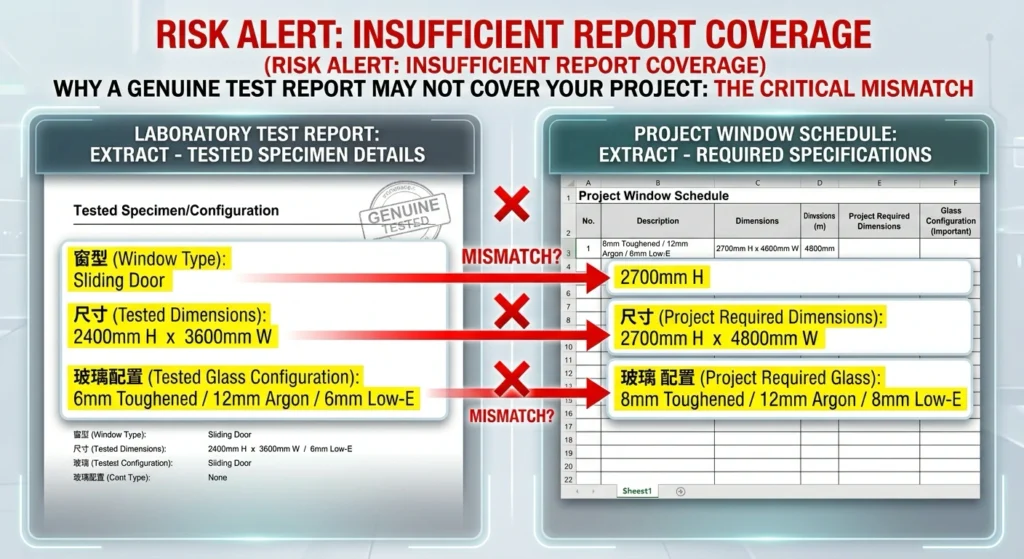
Rather than working through a generic supplier process, this section walks through the report document itself — the fields that should be present, and what a gap in each one tells you.
Why a Field-by-Field Read Matters More Than a Compliance Statement
Two reports can both reference AS2047 and still differ significantly in what they actually prove. Reading field by field is how you catch that difference before it becomes a project problem.
What You’ll Need Ready Before You Start
Have your drawings, window or door schedule, glass specification, project location, and target wind classification on hand so you can check each field against your own project as you go.
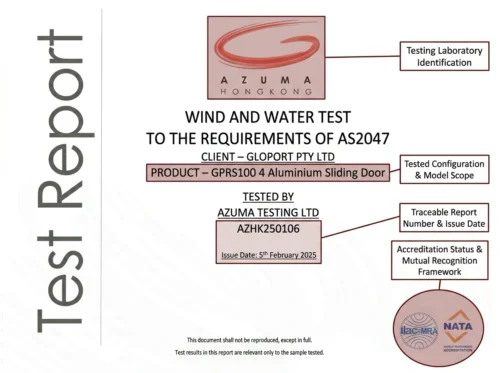
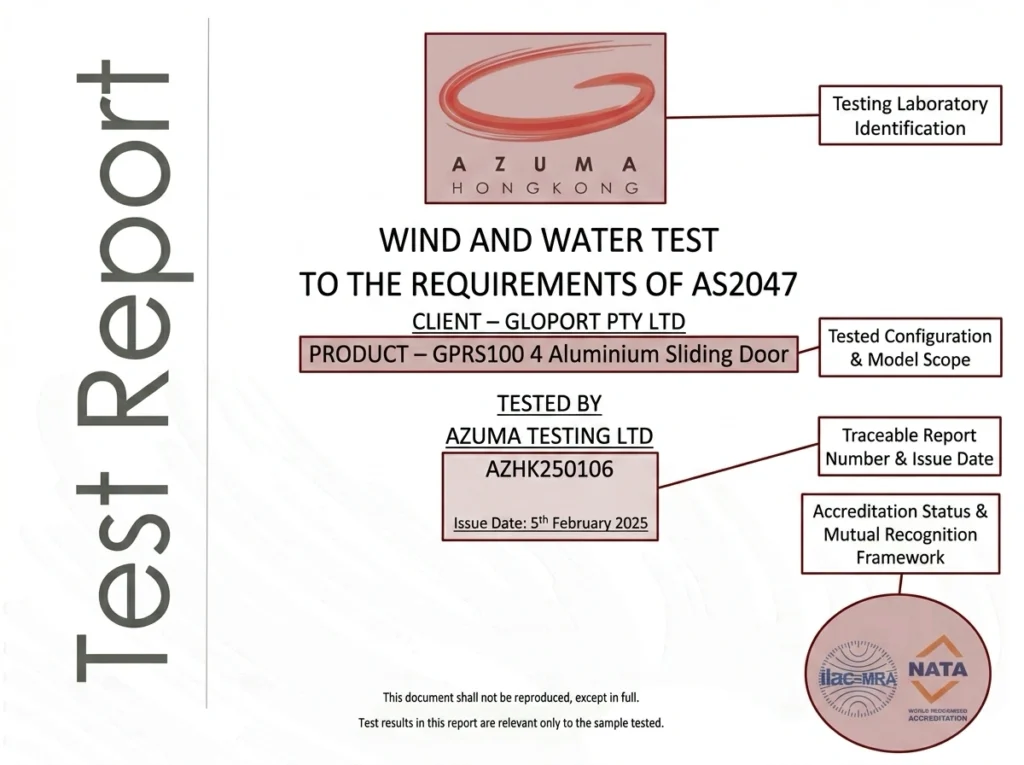
Field 1: Laboratory Name and Accreditation Status
What This Field Should Show
The report should clearly name the testing laboratory and its accreditation status. Depending on project requirements, this may need to be checked against NATA or, for overseas labs, against ILAC-MRA recognition for the relevant jurisdiction.
Red Flag: Accreditation That Can’t Be Verified
If the laboratory name is missing, unfamiliar, or its accreditation cannot be independently confirmed, treat this as a point to raise with the supplier before relying on the report for project sign-off.
[External Reference Placeholder 1: Standards Australia / NATA accreditation search — To be selected from external_reference_map.xlsx in Module 10B]
Field 2: Report Number, Issue Date, and Traceability
What This Field Should Show
A genuine report carries a unique report or reference number and an issue date, allowing it to be traced back to the laboratory that produced it and confirmed as current.
Red Flag: Reports Without a Traceable Number or Date
A general “compliance certificate” with no report number, or an undated document, cannot be verified against the laboratory’s own records. Depending on project requirements, your building surveyor may require the original report, not a summary letter.
Field 3: Tested Configuration — Profile, Size, and Glazing
What This Field Should Show
The report should identify the exact frame profile, size, glazing type and thickness, and hardware tested. This is the field to check directly against your drawings and window or door schedule.
Red Flag: A Configuration That Doesn’t Match Your Drawings
If your project uses a different size, a heavier glass build-up, or a different opening type than the tested specimen, the report may not apply. Any mismatch here should be flagged to your project’s building surveyor or structural engineer, not resolved informally between buyer and supplier.
[Image Placeholder 2: Window schedule template showing profile, glazing, and configuration fields to confirm against a test report]
Field 4: Test Categories Actually Performed
What This Field Should Show
AS2047 testing covers several mandatory physical performance categories — a complete report should show which of these were assessed for the tested configuration, and to what result.
Red Flag: A Report That Only Says “Compliant”
If a report references general “compliance” without identifying which test categories were performed and on what configuration, that is a gap worth raising with the supplier directly.
[Suggested Internal Link 2: AS2047 Test Methods Explained (Deflection, Air Infiltration, Water Penetration & More) — anchor: “AS2047 test categories” — Needs URL confirmation, pending publication]
[External Reference Placeholder 2: ILAC-MRA laboratory accreditation framework reference — To be selected from external_reference_map.xlsx in Module 10B]
Field 5: Wind Classification Result (N/C Rating)
What This Field Should Show
AS2047 wind classifications are grouped into non-cyclonic (N) and cyclonic (C) bands. The report should state the specific classification achieved for the tested configuration, which should then be checked against your project’s site-specific wind load requirement.
Red Flag: A Rating That Doesn’t Match Your Site
A wind classification that is lower than your project’s site requirement, or that isn’t stated at all, is a direct compliance risk — this should always be confirmed with your project’s consultant, since site wind loading varies by location and building type.
Field 6: Scope Statement and Limitations
What This Field Should Show
Many reports include a scope statement noting what the tested result does, and does not, cover. This is often the most overlooked field, and the most useful one for verification.
Where APRO Fits Into This Read
APRO’s practice on this point is straightforward: where AS2047 test reports exist for a specific tested model — including reports from Intertek and from NATA-accredited Azuma Testing conducted via Gloport Pty Ltd — they apply to that tested configuration only, not to the full product range. Project buyers should always request the report tied to the exact profile and glazing being quoted, rather than treating a single report as blanket certification for every product a supplier offers. Aluminum window compliance requirements should always be confirmed against your project’s own specification and local consultant guidance, since referencing under the National Construction Code and state-level requirements can vary by project type and jurisdiction.
Putting the Fields Together: A Verification Checklist
Once you’ve read through the six fields, the table below consolidates them into a single reference for supplier comparison.
| Field | 需要確認什麼 |
|---|---|
| Laboratory | Name and accreditation status (NATA or ILAC-MRA recognized where applicable) |
| Report number and date | Traceable reference number and a current issue date |
| Tested configuration | Profile, size, and glazing matching your drawings or schedule |
| Test categories | Deflection, operating force, air infiltration, water penetration, ultimate strength |
| Wind classification | N/C rating matching your project’s site requirement |
| Scope and limitations | What the report explicitly does and does not cover |
Before requesting final pricing, confirm:
- Your drawings and window / door schedule are finalized for the profiles you need
- The tested configuration matches what will actually be quoted
- The laboratory, report number, and issue date are documented and traceable
- The wind classification tested matches your project’s site requirement
- Any scope limitations noted in the report are understood before quotation
How This Plays Out in Commercial Projects
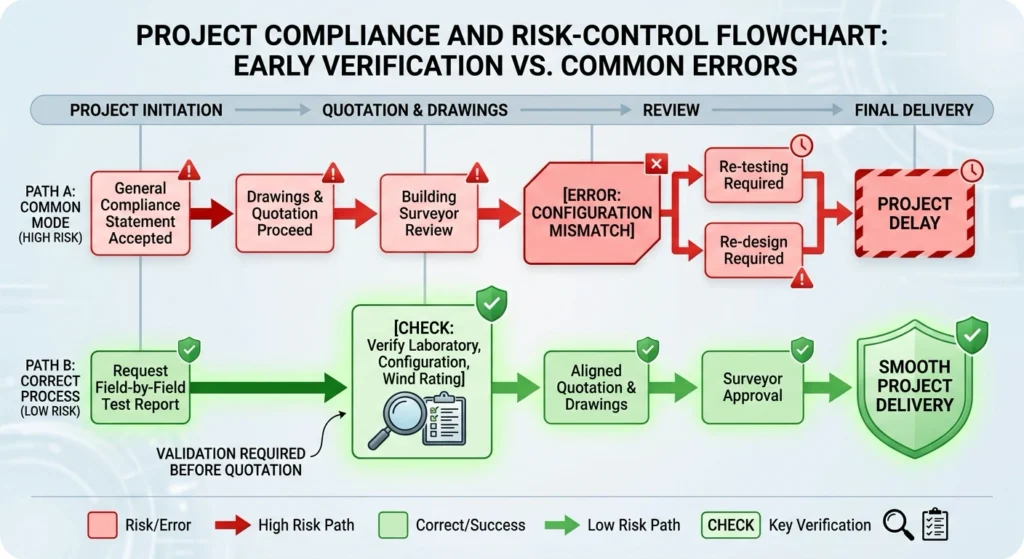
Verification gaps tend to follow a similar pattern across commercial aluminum window and door projects sourced overseas, even without reference to any specific project.
A Common Pattern in Overseas-Sourced Projects
A buyer receives a compliance statement referencing AS2047 testing early in supplier discussions. Drawings and quotation proceed on that basis. Later, during building surveyor review or site-specific wind assessment, the tested configuration does not match what was quoted — triggering a request for additional documentation or, in some cases, redesign.
Why This Matters Before Quotation, Not After
The earlier a field-by-field read catches this mismatch, the less it affects schedule and cost. This pattern is a general risk to watch for, not a claim about any particular supplier, and it should not replace your own project-specific verification.
[Image Placeholder 3: Risk-control flowchart showing verification checkpoints from drawings through to delivery]
Turning This Into a Repeatable Supplier Check
Reading a test report field by field is only useful if it becomes a standard step in how you compare suppliers, not a one-off check on a single project.
Building It Into Supplier Comparison
Run each shortlisted supplier’s report through the same six fields. This gives you a consistent basis for comparison instead of relying on each supplier’s own compliance summary, and it connects directly into aluminum window quotation requirements once you move to pricing.
What to Prepare Before You Ask
Have your drawings, window or door schedule, glass specification, project location, and target wind classification ready. This lets a supplier respond with a specific, traceable answer rather than a general compliance statement.
Next Step: Project Review or Quotation
Once you’ve worked through the fields, request a project review or quotation that references the verified test report scope directly, so pricing and documentation are aligned from the start.
常問問題
How do I verify if a window test report laboratory is NATA recognized?
Check the laboratory’s accreditation status directly, either through the laboratory’s own accreditation documentation or through the relevant accreditation body’s public register. For international labs, confirm recognition under ILAC-MRA arrangements where relevant to your project’s jurisdiction.
Can an overseas manufacturer use one AS2047 test report for all window profiles?
Not automatically. A test report applies to the specific configuration tested — profile, size, glazing, and hardware. Different configurations may require separate testing or supporting engineering assessment, which should be confirmed with your supplier and consultant.
What is the difference between an AS2047 test report and an AS2047 compliance label?
A test report is the underlying laboratory document showing what was tested and the results achieved. A compliance label or statement is a supplier’s summary claim, which should always be traceable back to a specific test report before being relied on for project sign-off.
Is an AS2047 test report sufficient for Australian building certifier approval?
Not on its own in every case. Building surveyors and certifiers may require the test report alongside other project-specific documentation, and requirements vary by project type, jurisdiction, and site conditions. This should be confirmed directly with your certifier.
What should project buyers confirm before requesting a quotation for an AS2047 test report?
To verify AS2047 test report coverage before quotation, confirm your drawings, window or door schedule, glass and hardware specification, project location, and required wind classification, so any test report reviewed can be checked field by field against your actual project scope.
What fields should I check first when reading an AS2047 test report?
Start with the laboratory name and accreditation, then the report number and issue date, before moving to the tested configuration and wind classification — a report missing the first two fields is difficult to verify at all.
報價前需要哪些圖面或清單?
Typically a window or door schedule, elevation drawings, glass specification, hardware and finish requirements, and project location are needed to confirm scope against any referenced test report.
What documents are needed before requesting a quotation for an AS2047 test report review?
Have your drawings, schedules, specifications, and target wind classification ready, along with any consultant requirements specific to your project’s jurisdiction.
結論/下一步該做什麼
Verifying an AS2047 test report is a documentation exercise, not a formality. The most reliable way to reduce risk is to read the report itself field by field and check it against your actual project drawings and specifications — before quotation, not after.
Before your next supplier conversation, prepare:
- drawings and window / door schedules
- glass and hardware specifications
- project location and target wind classification
- delivery assumptions and quotation scope
With this information ready, request a project review or quotation that references the specific test report scope relevant to your configuration, so compliance documentation and pricing are aligned from the outset.
行動號召
聯繫 APRO for project review or quotation connected to verified AS2047 documentation, and send drawings, window / door schedules, specifications, glass and hardware requirements, project location, delivery assumptions, and quotation scope.
This lets the review start from your actual project configuration rather than a general compliance statement.