Commercial Window Acoustic Test Report Guide for Buyers
Verify commercial window acoustic test reports, STC vs OITC ratings, laminated glass build-ups, and acoustic gaskets to eliminate project noise risks.
commercial-window-acoustic-test-report
Commercial Window Acoustic Test Report Compliance Guide for Project Buyers
Acoustic performance in commercial hotels, multi-family residential towers, and urban office buildings is a primary driver of tenant comfort and regulatory compliance. Fenestration assemblies located adjacent to busy arterial roads, rail transit corridors, and airport flight paths must satisfy strict exterior sound transmission criteria. However, procurement teams frequently encounter vendor proposals citing generic glass manufacturer sound ratings rather than laboratory-verified assembly performance. When acoustic specifications fail on site, building owners face expensive retrofit interventions and severe tenant noise complaints. This technical guide examines how to interpret a commercial window acoustic test report, differentiate between Sound Transmission Class (STC) and Outdoor-Indoor Transmission Class (OITC), and verify aluminum window frame acoustic engineering.
:::tip [Featured Snippet: Acoustic Test Report Essentials]
A valid commercial window acoustic test report documents laboratory transmission loss testing across 16 or 21 one-third octave frequency bands (80 Hz to 5,000 Hz) in accordance with ASTM E90 / ASTM E413 (for STC) and ASTM E1332 (for OITC) or ISO 10140 / ISO 717-1 (for R_w + C_tr). Commercial project buyers must verify that acoustic ratings represent the entire glazed aluminum window assembly—including frame thermal breaks, sash perimeter EPDM compression seals, and locking hardware—rather than bare center-of-glass laboratory samples.
:::
問題:專案買家為何失去控制權
What it means
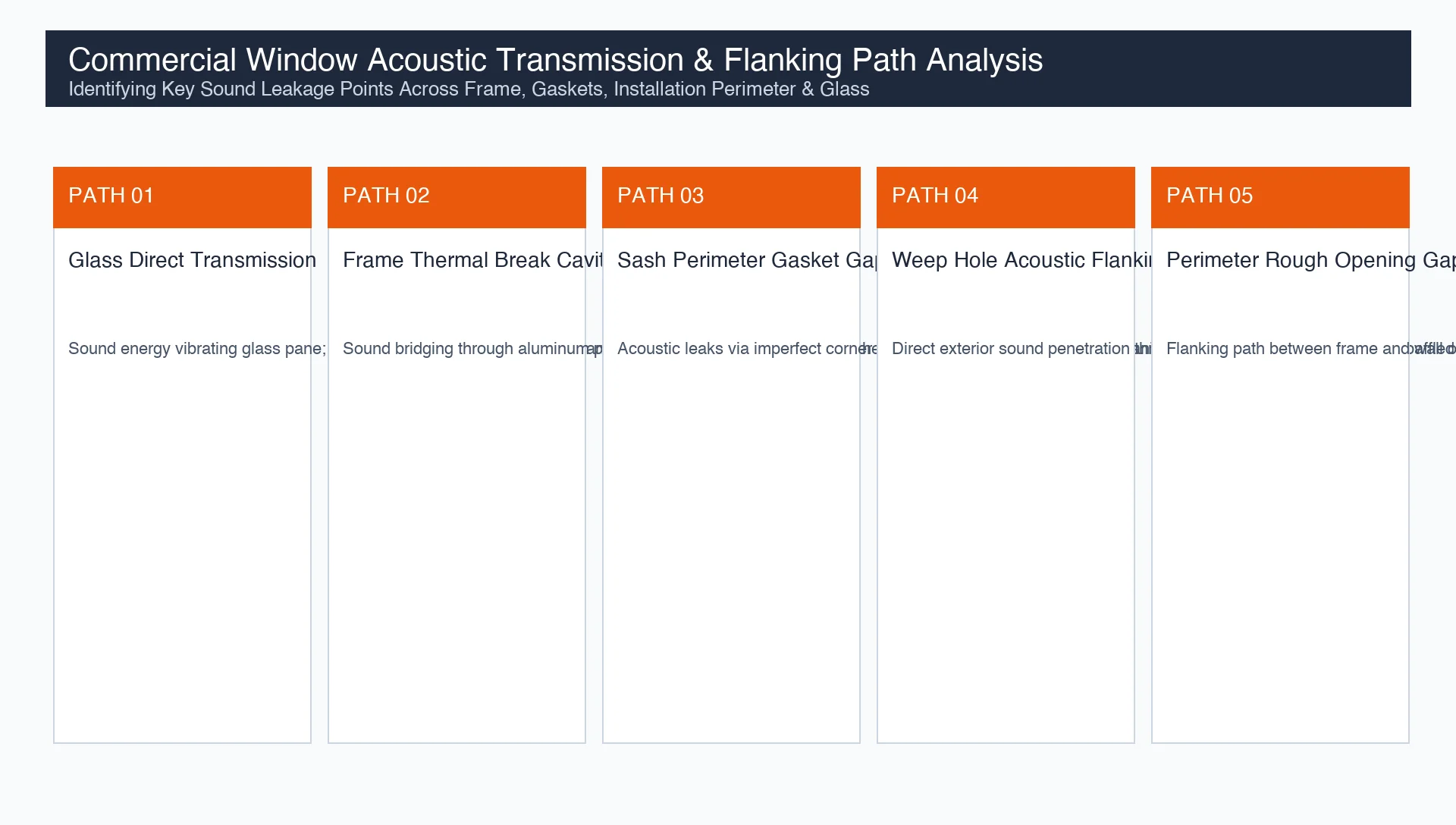
Project buyers lose technical control when acoustic specifications are treated as a simple glass thickness calculation rather than an integrated fenestration system. Sound travels through the path of least resistance (acoustic flanking); even a high-performing acoustic glass unit will fail project noise criteria if installed into an aluminum frame with insufficient gasket compression, unsealed corner joints, or single-chamber extrusion designs.
How to apply
When reviewing vendor acoustic submittals, project teams should watch for four critical acoustic performance pitfalls:
1. Center-of-Glass (COG) vs. Whole-Window Conflation: An acoustic report showing STC 42 for a glass sample in an isolated laboratory frame typically achieves only STC 34 to 36 when installed into an operable aluminum sash.
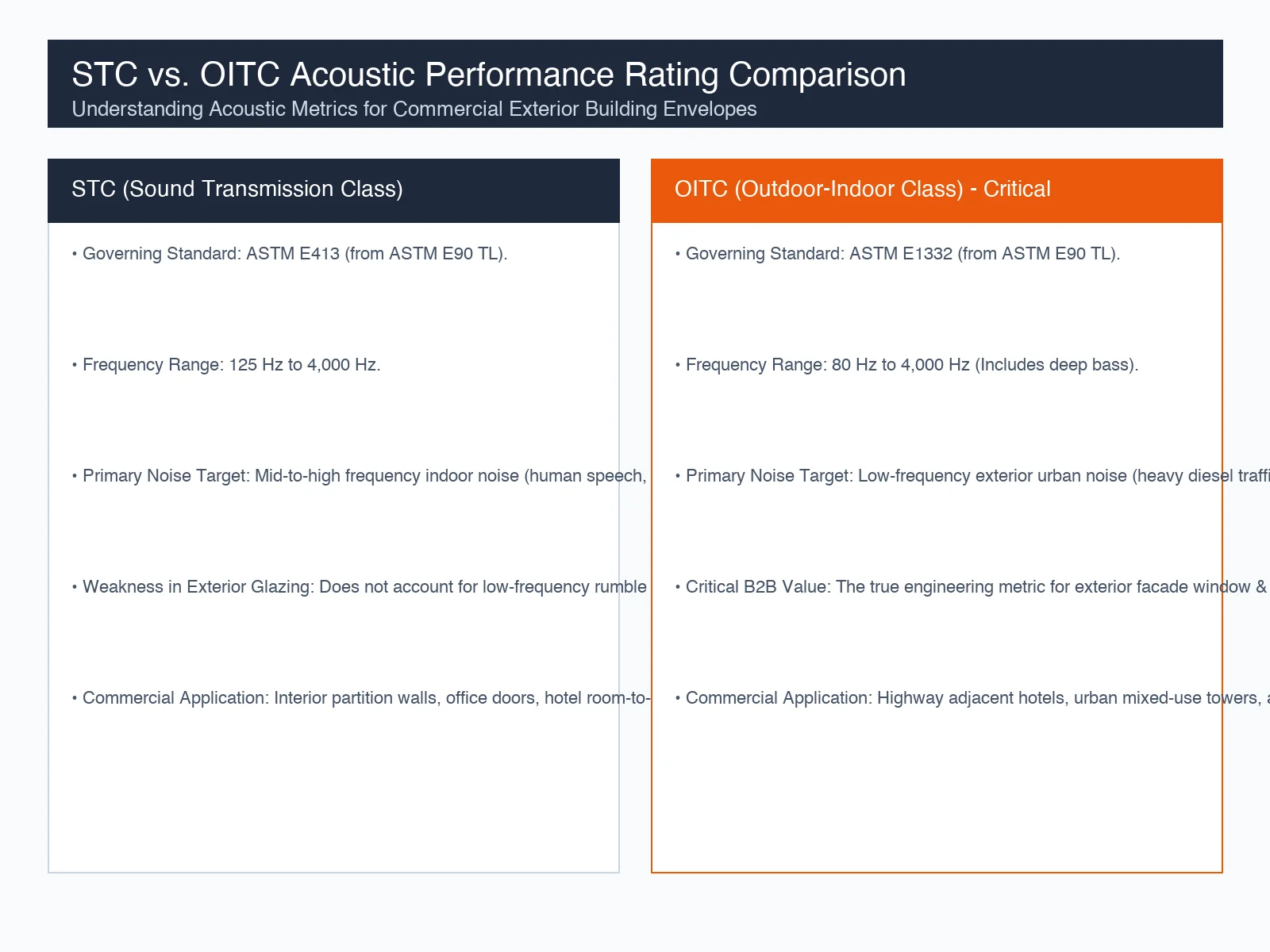
2. STC vs. OITC Misapplication: Relying exclusively on STC (weighted for human speech, 125 Hz – 4,000 Hz) for airport or highway projects where low-frequency transportation noise (80 Hz – 4,000 Hz) requires OITC optimization.
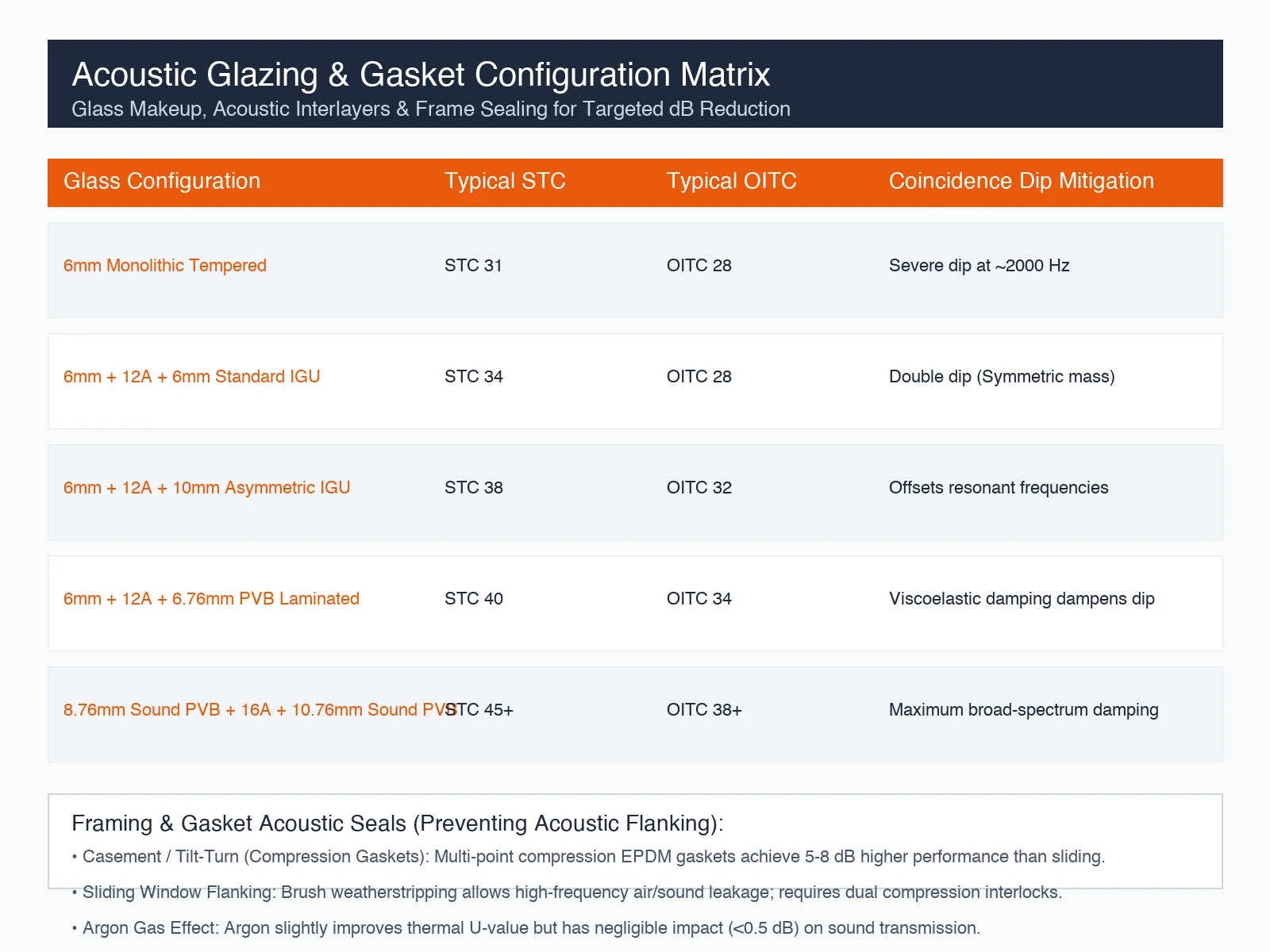
3. Symmetric Glass Resonant Coincidence: Using symmetric double glazing (e.g., 6 mm + 12Air + 6 mm), where both panes vibrate at identical resonant frequencies, creating a severe acoustic “coincidence dip” that degrades sound insulation.
4. Sliding Window Weatherstrip Leakage: Installing standard sliding windows with brush wool-pile seals in high-noise zones instead of compression-sealed casement, tilt-and-turn, or lift-and-slide assemblies.
Manual review note
Always require suppliers to submit complete dual-reverberation test chamber reports (ASTM E90) showing the full transmission loss (TL) curve across all octave frequency bands from 80 Hz to 5,000 Hz. Cross-reference laboratory audit requirements in our commercial window test reports compliance guide.
Strategy Name: Project-Ready Supplier Review Framework
What it means
這 Project-Ready Supplier Review Framework establishes a structured engineering workflow for evaluating supplier acoustic submittals against acoustic consultant specifications and site noise criteria.
How to apply
This methodology breaks the acoustic procurement process into three disciplined phases:
Manual review note
Aligning acoustic performance with structural and thermal requirements early ensures balanced glazing unit weights and prevents premature hardware wear.
框架步驟 1:確認範圍和圖紙
What it means
Acoustic fenestration evaluation starts by analyzing architectural floor plans, façade elevations, and acoustic consultant reports to map sound mitigation requirements across building exposures.
How to apply
1. Map Façade Noise Zones: Differentiate between high-exposure exterior façades (e.g., highway-facing elevations requiring STC 38+ / OITC 32+) and sheltered courtyard elevations requiring standard STC 30 to 32.
2. Review Window Schedule Opening Types: Ensure operable units in noise-sensitive zones utilize compression-sealed opening systems (casement, awning, tilt-and-turn, or lift-and-slide).
3. Verify Sash Weight & Hardware Compatibility: Heavy acoustic glass makeups (e.g., 10 mm + 16Ar + 8.76 mm Lam ≈ 48 kg/m²) require heavy-duty commercial friction stays and robust corner crimping. Cross-reference window schedules and shop drawings in our window and door submittal package guide.
Manual review note
Check perimeter rough opening dimensions to ensure sufficient clearance (15 mm to 20 mm) for high-density acoustic perimeter backing rods and non-hardening acoustic sealants.
框架步驟 2:檢查技術和合規性要求
What it means
A technical audit evaluates the manufacturer’s acoustic test report against recognized standards (ASTM E90, ASTM E413, ASTM E1332, ISO 10140, ISO 717-1).
How to apply
1. Differentiate STC vs. OITC Metrics:
2. Audit Asymmetric Glass Build-ups: To eliminate resonant coincidence dips, verify that exterior and interior glass panes differ in thickness by at least 30% (e.g., 8 mm + 6 mm or 10 mm + 6 mm).
3. Verify Acoustic Interlayer Specification: Confirm whether laminated glass assemblies utilize specialized acoustic-grade PVB (Polyvinyl Butyral with viscoelastic core) rather than standard structural PVB.
4. Clarify Gas Fill Acoustic Impact: Note that while Argon gas significantly improves thermal U-factors, its acoustic dampening effect is negligible (< 0.5 dB). Acoustic sound transmission loss is governed primarily by glass mass, asymmetric thickness, and viscoelastic interlayer dampening.
5. Examine Frame Multi-Chamber & Gasket Design: Aluminum profiles must incorporate multi-chamber PA66 GF25 thermal breaks and continuous dual or triple EPDM compression gaskets with vulcanized molded corners. Cross-reference profile weather-tightness standards in our NAFS window performance ratings guide.
Manual review note
Verify that the testing laboratory is accredited under ISO/IEC 17025 and that test reports document ambient background noise correction and specimen perimeter flanking seals.
框架步驟 3:檢視報價和交付假設
What it means
Acoustic performance must be reflected accurately in production line items, bill of materials (BOM), and crating specifications.
How to apply
1. Verify Glass and Interlayer Brand Codes in Quotes: Ensure that quotations explicitly cite acoustic PVB brands, exact glass thicknesses, and warm-edge spacer specifications.
2. Check Multi-Point Hardware Groupings: Confirm that operable sash quotes include multi-point perimeter locking hardware to guarantee uniform gasket compression along all four sash edges.
3. Review Crate Packaging and Transit Protection: Heavy acoustic glazed units must be packed in reinforced timber crates with heavy-duty corner guards. Review commercial aluminum window systems and packaging logistics during tender analysis.
Manual review note
Ensure that quotes clearly state whether factory-glazed assemblies or site-glazing protocols are assumed, as factory-glazed units provide superior acoustic gasket quality control.
Real Laboratory Test Data & Engineering Case Study (Intertek ASTM E90-23)
What it means
To demonstrate how acoustic engineering principles translate into verified laboratory performance, APRO submitted full-scale commercial fenestration specimens from the APRO A80T Thermal Break Series 到 Intertek Testing Services for dual-reverberation chamber acoustic testing in accordance with ASTM E90-23, ASTM E413-22 (STC), and ASTM E1332-22 (OITC).
Real Laboratory Benchmark (Intertek Report Nos. 241127015SHF-001 & 241127015SHF-002)
Unlike generic data sheets that only test small isolated glass coupons (1200 mm × 1200 mm), APRO evaluated full-scale oversized commercial assemblies (over 5.2 m² to 5.5 m² in specimen area) replicating true architectural floor-to-ceiling elevations:
| 範圍 | APRO A80T Awning Window Assembly | APRO A80T Hinged Door Assembly |
|---|---|---|
| **Accredited Laboratory** | Intertek Testing Services (Shanghai Fengxian) | Intertek Testing Services (Shanghai Fengxian) |
| **Official Test Report No.** | **241127015SHF-002** (Issued: Dec 2024) | **241127015SHF-001** (Issued: Dec 2024) |
| **Test Method & Standards** | ASTM E90-23 / ASTM E413-22 / ASTM E1332-22 | ASTM E90-23 / ASTM E413-22 / ASTM E1332-22 |
| **Specimen Dimensions (W × H)** | **1829 mm × 2794 mm** (Specimen Area: 5.2 m²) | **1930 mm × 2794 mm** (Specimen Area: 5.5 m²) |
| **Frame System** | APRO A80T Heavy-Duty Multi-Chamber Thermal Break | APRO A80T Heavy-Duty Multi-Chamber Thermal Break |
| **Glazing Build-Up** | 8mm + 12Ar + 6mm + 12Ar + 6mm + 1.52mm Acoustic PVB | 8mm + 12Ar + 6mm + 12Ar + 6mm + 1.52mm Acoustic PVB |
| **Sound Transmission Class (STC)** | **STC 40** (Whole Window Assembly Rating) | **STC 40** (Whole Door Assembly Rating) |
| **Outdoor-Indoor Transmission (OITC)** | **OITC 34** (Whole Window Assembly Rating) | **OITC 33** (Whole Door Assembly Rating) |
| **Transmission Loss at 100 Hz** | 22.9 dB | 20.5 dB |
| **Transmission Loss at 250 Hz** | 33.5 dB | 34.7 dB |
| **Transmission Loss at 500 Hz** | 38.4 dB | 36.5 dB |
| **Transmission Loss at 1000 Hz** | 40.4 dB | 38.6 dB |
| **Transmission Loss at 2000 Hz** | 42.7 dB | 41.7 dB |
| **Transmission Loss at 4000 Hz** | 51.6 dB | 51.9 dB |
Engineering Takeaways for Project Buyers
1. Low-Frequency Traffic Attenuation (OITC 34): By pairing an asymmetric triple-glazed unit with an acoustic PVB laminated core and heavy PA66 thermal barrier, the A80T window achieved 33.5 dB transmission loss even at the challenging 250 Hz traffic rumble zone.
2. Whole-Assembly Certification Integrity: The STC 40 rating applies to the complete operable window and frame system, verifying that APRO multi-point perimeter compression seals completely prevent acoustic flanking leakage under ASTM E90 dual-chamber testing.
Manual review note
For coastal commercial developments, high-speed rail corridors, and airport hospitality projects, specifying third-party accredited full-scale assembly test reports ensures code compliance with zero risk of post-occupancy acoustic failure.
風險控制邏輯
What it means
Acoustic risk control requires an end-to-end quality assurance chain connecting design specifications, lab testing, factory assembly, and on-site installation.
How to apply
1. Audit Upstream Test Reports: Verify full assembly test credentials before contract finalization.
2. Inspect Factory Corner Construction: Ensure aluminum profile miter corners are mechanically crimped with injected two-part structural polyurethane sealant.
3. Enforce Jobsite Acoustic Perimeter Detailing: Mandate high-density backer rods and continuous acoustic perimeter sealant beads on both interior and exterior joints per ASTM E966 guidelines.
Manual review note
Flanking sound transmission through hollow perimeter installation voids can degrade overall site acoustic performance by up to 8 dB.
專案買家如何應用該框架
What it means
Procurement teams should adopt a standardized verification checklist when issuing RFQs for noise-sensitive commercial projects.
How to apply
1. Distribute Standardized Technical Data: Issue complete window schedules with clear target STC and OITC values.
2. Require Certified System Details: Request CAD profile cross-sections showing gasket compression lines, thermal breaks, and glass pocket depths.
3. Engage Technical Engineering Support: Collaborate with APRO’s engineering team to analyze project noise criteria, evaluate profile acoustic compatibility, and obtain comprehensive quotation documentation.
Manual review note
Suppliers offering transparent engineering calculations, verified laboratory reports, and clear scope definitions provide maximum acoustic risk mitigation.
Why is OITC more important than STC for hotel and urban apartment windows?
STC (Sound Transmission Class) measures sound attenuation across mid-to-high frequencies (125 Hz – 4,000 Hz), which correlates well with interior speech and office noise. OITC (Outdoor-Indoor Transmission Class) measures sound transmission down to 80 Hz, accurately capturing low-frequency transportation noise such as diesel truck engines, aircraft, and rail rumble. For exterior building envelopes in urban settings, OITC is the critical benchmark.
Does adding triple glazing automatically make a window soundproof?
No. Standard triple glazing with symmetric glass panes and narrow air cavities (9 mm – 12 mm) performs well thermally but often underperforms acoustically due to multiple mass-air-mass resonances. An asymmetric double-glazed unit with an acoustic laminated pane and a wide gas cavity (16 mm – 20 mm) typically delivers superior acoustic attenuation at lower cost and weight.
Does Argon gas in the glass cavity improve acoustic performance?
No. While Argon gas improves thermal insulation (lowering U-factors), its effect on acoustic transmission loss is negligible (< 0.5 dB). Acoustic insulation is governed by glass mass, pane thickness asymmetry, and viscoelastic acoustic PVB interlayers.
What is the maximum STC rating achievable with aluminum windows?
Commercial operable aluminum windows with thermal breaks, multi-point compression locks, and heavy asymmetric laminated glass typically achieve STC ratings between 42 and 45. Specialized fixed architectural secondary glazing assemblies can achieve STC ratings of 48 to 52.
Can a sliding door achieve an STC 40 rating?
Standard sliding doors with wool-pile brush weatherstripping typically achieve STC 28 to 32 due to sound leakage through the top and bottom guide tracks. To achieve STC 38 to 40, sliding systems must utilize heavy-duty Lift & Slide mechanisms with continuous EPDM compression gaskets that seal tightly against the frame upon closing.
What should project buyers confirm before requesting a quotation for commercial window acoustic test report?
Buyers should confirm exterior noise sources, required STC and OITC ratings, target window opening dimensions, operable vs. fixed configurations, and structural wind pressure criteria.
除了單價之外,買家如何評估供應商?
Buyers should evaluate suppliers by auditing third-party lab test validity, profile extrusion structural stiffness, EPDM gasket quality, hardware warranty tiers, and export packaging reliability.
Achieving verifiable acoustic comfort in commercial buildings requires rigorous technical alignment between architectural specifications, glass engineering, and window frame manufacturing. Verifying whole-assembly acoustic test reports early prevents costly noise remediation and tenant disputes.
Action Steps for Your Procurement Team:
1. Review acoustic consultant reports to extract required STC and OITC performance metrics.
2. Require shortlisted suppliers to provide whole-window ASTM E90 / ASTM E1332 laboratory test reports.
3. Verify that proposed glass configurations feature asymmetric pane thicknesses and acoustic PVB interlayers.
4. Submit project drawings to an engineering-focused manufacturer for acoustic submittal review.
For technical review of your project’s commercial window acoustic test reports and glazing specifications, contact APRO. Send your architectural elevations, window schedules, and acoustic criteria for a comprehensive engineering assessment and tailored quotation package.