















Introduction
A quotation request for imported aluminum windows can look complete and still be missing the documentation a project actually needs. AS2047 import documentation mistakes usually surface later — during technical review, compliance checking, or site inspection — after the quotation has already been priced and scope has already been assumed.
This article catalogs the specific documentation mistakes that most often trip up contractors, dealers, and distributors sourcing aluminum windows overseas, why each one happens, and how one mistake tends to create the next.
It is written around failure patterns, not a generic pre-quotation process — for the broader step-by-step scope-to-quotation workflow, see the related project decision checklist linked below.

Where AS2047 Documentation Mistakes Start
AS2047 import documentation mistakes usually start with unclear scope, mismatched drawings, or compliance evidence that was never checked against the project — not with a single missing form.
These gaps typically stay hidden until a consultant or certifier reviews the file, often after quotation and production planning are already underway.
- Drawings and schedules are shared before glass, finish, or hardware details are finalized.
- Compliance documents are assumed to be included without checking what they actually cover.
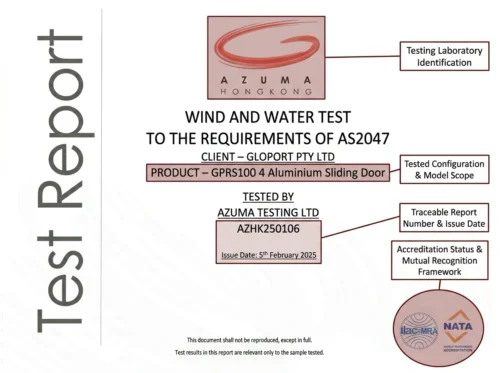
- Test reports are referenced by standard name only, without report number, issue date, or product scope.
- Quotation and delivery assumptions are agreed verbally, then not reflected in the final documentation package.

Common AS2047 Import Documentation Mistakes
Most import documentation problems fall into one of five recurring patterns. Each one is a specific point where a buyer accepted, assumed, or overlooked something that later didn’t hold up under review.
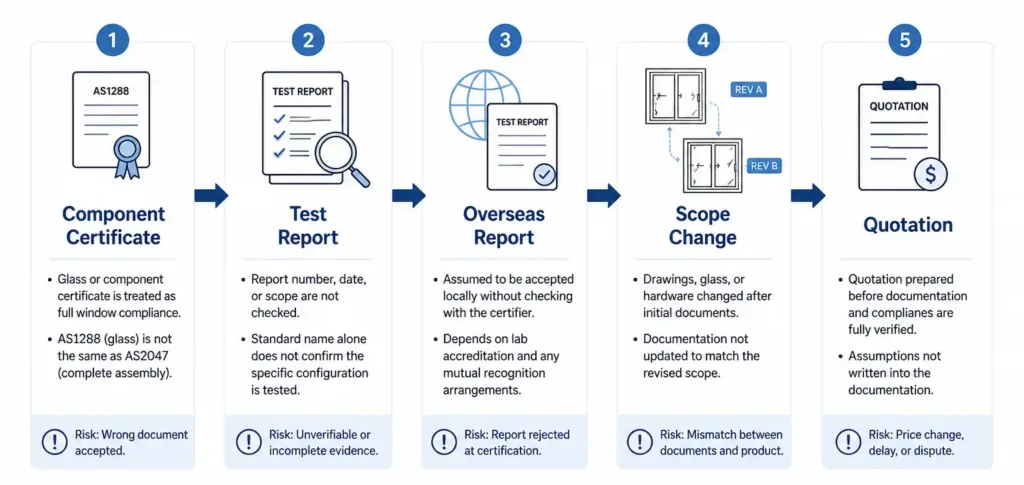
Mistake 1: Treating a Component Certificate as Full Assembly Compliance
This article assumes you already know what AS2047 covers and what a compliant configuration looks like — for that background, see the AS2047 compliance guide linked below. Here the focus is narrower: catching the specific point where a document gets misread during import, starting with this one.
A glass-only certificate or a component-level test report may not, by itself, demonstrate compliance for a complete window or door assembly.
AS1288 addresses glazing requirements for the glass itself, while AS2047 addresses the performance of the complete window or door assembly — buyers who accept an AS1288 certificate as proof of AS2047 compliance are checking the wrong document. Confirm with the local consultant whether a document covers the full assembly or only one component within it.
Mistake 2: Accepting Test Reports Without Checking Report Number, Date, or Scope
A standard name alone — “AS2047 tested” — does not confirm anything about the specific product configuration involved. The table below shows what to check before accepting a compliance document as sufficient.
| What to Check | Why It Matters | Buyer Action |
|---|---|---|
| Standard referenced (e.g., AS2047) | Indicates which performance categories the document is meant to cover | Confirm the standard applies to the product type and configuration ordered |
| Report or certificate number | Distinguishes a specific test result from a general product claim | Request the number and check it against the document itself |
| Issue date | Helps confirm whether the evidence is current for the product configuration | Confirm the date aligns with the current product and glass configuration |
| Issuing body | Indicates who performed or issued the testing | Confirm the issuing body and ask how the report was obtained |
| Product scope in the document | Helps confirm whether the document covers the exact configuration ordered | Compare the documented configuration against the confirmed schedule |
Mistake 3: Assuming Any Overseas Lab Report Will Be Accepted Locally
Acceptance of an overseas test report is not automatic and depends on project-specific review by the local certifier or consultant. It also depends on the certifying body involved and any relevant mutual recognition arrangements — buyers who assume acceptance without confirming it risk the report being rejected at the point it matters most, during certification or inspection.
Mistake 4: Letting Documentation Go Stale After Scope Changes
Compliance evidence is tied to a specific product configuration, not to a standard name alone. When glass, finish, hardware, or quantities change after documentation is first issued, the original evidence may no longer apply — buyers who don’t re-check documentation after a scope change often don’t discover the mismatch until a consultant or certifier catches it.
Mistake 5: Requesting a Quotation Before Documentation Gaps Are Resolved
A quotation issued against an unconfirmed scope or unverified compliance document usually needs to be revised once those gaps surface — by then, pricing, delivery assumptions, and production planning may already be locked in around the wrong configuration. Resolving scope and compliance questions before requesting a price, rather than after, avoids this rework.
How One Documentation Gap Leads to Another
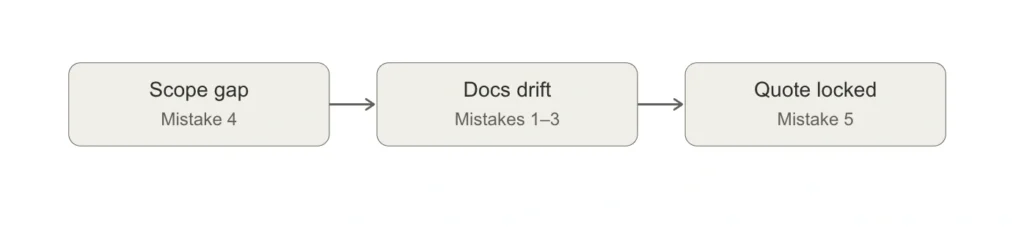
These mistakes rarely happen in isolation. A scope gap (Mistake 4) often means the compliance document on file no longer matches the product (Mistakes 1–3), and a quotation requested before that’s resolved (Mistake 5) locks in pricing around a configuration that still needs to change.
Treating documentation as one connected chain — scope, then compliance evidence, then quotation — rather than separate checkboxes is what keeps one early mistake from causing two or three more downstream.
Where These Mistakes Show Up in Real Projects
Documentation mistakes tend to follow similar patterns across overseas sourcing projects, even though every project’s drawings and specifications are different.
- Projects that accepted a glass-only certificate as proof of full compliance often discovered the gap only during certifier review.
- Projects where schedules changed after documentation was issued often needed a revised quotation and a re-checked compliance document.
- Projects that requested overseas test reports without confirming local acceptance faced delays when the report was later questioned.
- Projects that resolved scope and compliance questions before requesting a quotation generally moved to production with fewer open questions at technical review.
Specific project names, client details, and figures are not included here, as APRO does not publish named case data. Buyers should request project-specific documentation and evaluation directly.
Quick Reference: Verifying Documentation Before You Request a Quotation
- Confirm the compliance document covers the full assembly, not just the glass or another single component.
- Check the report number, issue date, issuing body, and product scope against the confirmed schedule.
- Confirm whether an overseas lab report needs local certifier or consultant acceptance before it can be relied on.
- Re-check documentation any time scope, glass, finish, or hardware changes.
- Resolve scope and compliance questions before requesting a quotation, not after.
For the complete pre-quotation process — confirming scope and drawings, technical requirements, and quotation assumptions step by step — see [Suggested Internal Link 1: link to APRO’s aluminum window project decision checklist article — Needs URL confirmation].
To discuss a specific project’s documentation, send APRO your drawings, schedules, specifications, glass and finish/hardware requirements, project location, and delivery assumptions for review.
FAQ

Is an AS1288 glass certificate sufficient to prove AS2047 compliance for imported windows?
No. AS1288 addresses glazing requirements for glass, while AS2047 addresses the performance of the complete window or door assembly. A glass certificate alone does not demonstrate assembly-level compliance, so buyers should confirm what a document actually covers before relying on it.
Can Chinese laboratory test reports be accepted for AS2047 compliance in Australia?
Acceptance is not automatic and depends on project-specific review by the local certifier or consultant. It also depends on the certifying body involved and any relevant mutual recognition arrangements, so buyers should confirm acceptance directly rather than assuming any overseas report will be accepted without review.
What happens if imported windows lack proper AS2047 documentation during site inspection?
Missing or incomplete documentation can lead to delays, additional testing requests, or rejection during consultant or certifier review. Confirming documentation before shipment reduces the risk of this happening after the project timeline is already committed.
What documents should I request from a window manufacturer before signing a contract or quotation?
Typically: current drawings, window and door schedules, glass and performance specifications, finish and hardware details, any available compliance documentation with report numbers and issue dates, and written delivery assumptions.
What should project buyers confirm before requesting a quotation for AS2047 import documentation mistakes?
Confirm scope and drawings first, then verify that compliance evidence matches the current configuration, then review the quotation against what was actually documented. Requesting a quotation before these are resolved increases the chance of a mismatch later.
How can buyers evaluate suppliers beyond unit price?
Look at how clearly a supplier requests and reviews scope, how specific their compliance documentation is, and whether their quotation reflects the confirmed project details rather than a general estimate.
What drawings or schedules are needed before quotation?
Current architectural or shop drawings, a matching window and door schedule, glass and performance requirements, finish and hardware selections, and the project location.
What documents are needed before requesting a quotation for AS2047 import documentation mistakes?
The same core package: drawings, schedules, glass and performance specifications, finish and hardware requirements, project location, and any compliance documentation available for review at that stage.
Conclusion / What to Do Next
Most AS2047 import documentation mistakes trace back to one of five patterns: treating a component certificate as full compliance, accepting a test report without checking its number, date, or scope, assuming an overseas report will be accepted locally, letting documentation go stale after a scope change, or requesting a quotation before these gaps are resolved.
Catching them before a quotation is priced is far cheaper than catching them at certifier review.
Before requesting a project review or quotation, prepare:
- current drawings and window/door schedules
- glass, finish, and hardware specifications
- project location and any relevant site conditions
- delivery assumptions and target timeline
- any compliance documentation already available for review, including report numbers and issue dates
CTA

For a project review or quotation related to AS2047 import documentation mistakes, send APRO your project package so it can be reviewed against confirmed scope before pricing, rather than against a general product list:
- drawings and window/door schedules
- specifications, glass, finish, and hardware requirements
- project location
- delivery assumptions
- quotation scope