













In short: AS2047 requires two different nomination paths depending on building type — N1 through N6 for housing and other residential buildings, or a design wind pressure for commercial buildings. Many scope and quotation problems trace back to this fork being confirmed late, assumed instead of checked, or applied inconsistently across a project. This guide focuses specifically on that decision point and what to confirm once it’s resolved.
Introduction
APRO already has a broader compliance guide covering AS2047 as a whole, including BAL, glazing safety, and facade testing. This article is narrower on purpose: it exists because the N1–N6 vs. design wind pressure decision is easy to get wrong on its own, independent of any other AS2047 requirement, and it’s usually the first thing that goes unconfirmed on a project.
A window schedule that says “N1–N6 compliant” doesn’t tell a project buyer which path was actually used to get there, or whether it was the right one for the building type.
AS2047 splits this into two nomination methods — N1 through N6 for housing and residential buildings, or a design wind pressure for commercial buildings — and applying the wrong one, or applying it inconsistently across a mixed-use project, is where mismatches usually start.
This guide sets out a structured way for contractors, dealers, distributors, and architects to confirm which nomination path applies, and what to check once it’s confirmed, before comparing suppliers or requesting a quotation. For AS2047 requirements beyond wind rating — BAL, glazing safety, facade testing — see this article.
Problem: Why Project Buyers Lose Control
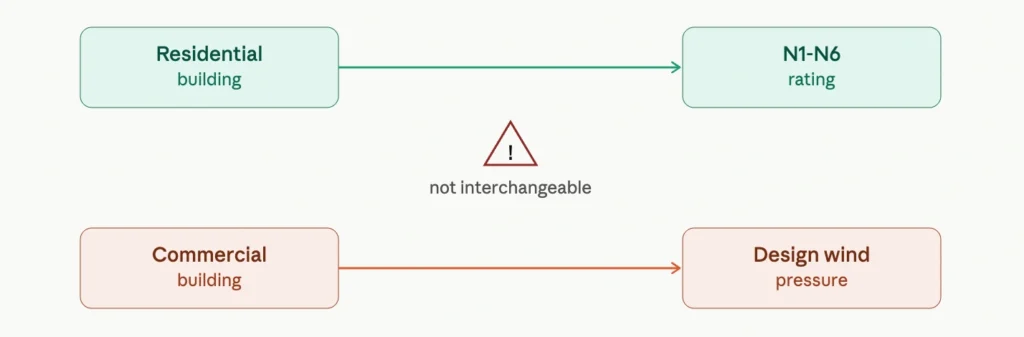
AS2047 wind rating N1–N6 is the classification system Australian specifiers must nominate for housing and residential buildings; commercial buildings instead require a nominated design wind pressure, not an N1–N6 classification.
Project buyers lose control of this requirement when the building type — and therefore the correct nomination path — isn’t confirmed before drawings, schedules, and supplier compliance claims are finalized.
The recurring failure isn’t a missing wind classification. It’s the wrong one, or an assumed one, applied to a building type it doesn’t fit.
- A residential-classified project schedule references a design wind pressure with no N1–N6 nomination behind it, or the reverse — a commercial project schedule shows “N1–N6” with no corresponding pressure figure.
- A mixed-use project has some openings that should follow the housing/residential path and others that should follow the commercial path, but the schedule treats the whole building the same way.
- A supplier’s quotation states “AS2047 compliant” without saying which nomination method the compliance claim is even based on.
- Site exposure, terrain category, or shielding conditions change between design and ordering, but no one revisits which nomination path — let alone which specific rating — still applies.
Where Buyers Lose Time and Leverage

Each of these gaps is minor on its own, but they compound. A contractor who accepts a compliance statement without confirming which nomination path it’s based on is carrying risk that typically surfaces downstream — at certification, at site inspection, or at practical completion.
Confirming the building classification and nomination path before ordering can help move that risk to the point where it is usually easiest and least costly to resolve, rather than later when it is more disruptive.
APRO’s Perspective on This Risk
Project buyers often need supplier input before every drawing, schedule, or specification detail is fully resolved. Treating the N1–N6 vs. design wind pressure decision as a project-specific fork — one that depends on building classification, not just location — rather than a single checkbox is what keeps scope and quotation aligned.
AS2047 Wind Rating N1-N6 Supplier Review Framework

A structured review, applied before comparing suppliers or requesting pricing, keeps the correct nomination path tied to the actual building type rather than assumed from location alone.
The framework below covers three steps: confirming scope and the applicable nomination path, checking technical and compliance requirements against that path, and reviewing quotation and delivery assumptions.
- Step 1 — Confirm scope and drawings. Establish whether the project follows the N1–N6 path or the design wind pressure path, opening by opening if needed.
- Step 2 — Check technical and compliance requirements. Review what a supplier’s compliance statement should include for the applicable path.
- Step 3 — Review quotation and delivery assumptions. Confirm the quotation reflects the same path and classification verified in Steps 1 and 2.
Depending on project requirements, buyers may need to work through these steps more than once as drawings are revised or site conditions are reconfirmed.
Manual Review Note
Requirements vary by market, project type, and local consultant expectations, so treat this framework as a starting structure, not a substitute for local verification with a certifier, consultant, or building surveyor.
Framework Step 1: Confirm Scope and Drawings

Before requesting quotations, confirm which nomination path the project actually follows — this is the decision the rest of the framework depends on.
- Classify the building. Housing and other residential buildings nominate a wind classification (N1–N6). Commercial and other buildings instead nominate a design wind pressure. Confirm this classification with the project’s engineer, certifier, or specification consultant — don’t infer it from the building’s general appearance or use.
- Check for mixed classification within one project. A multi-use building can have residential-classified and commercial-classified sections; each may follow a different nomination path, and the drawings should reflect that per opening or per zone, not as a single blanket value.
- Confirm the specific rating or pressure shown on the drawings or specification, and note where it came from.
- Cross-check the window and door schedule against the drawings to confirm opening sizes, quantities, and locations match what the nomination was assessed against.
- Note the glass configuration, frame system, and finish referenced in the specification, since compliance is tied to a specific tested configuration, not a product family in general.
For system selection and shop drawing coordination at this stage, see APRO aluminum window systems product page.
What Buyers Should Have in Hand Before Moving to Step 2
Drawings and shop drawings, a current window/door schedule, the specification section covering wind classification or design wind pressure, and — most importantly — written confirmation of the building’s classification are the minimum inputs. Without that classification confirmed, Step 2 can’t be completed accurately.
Manual Review Note
If the building classification, or the wind classification/design wind pressure itself, is not clearly stated anywhere in the project documents, this should be confirmed with the project’s engineer or certifier before proceeding — do not assume either based on general location or building appearance alone.
Framework Step 2: Check Technical and Compliance Requirements
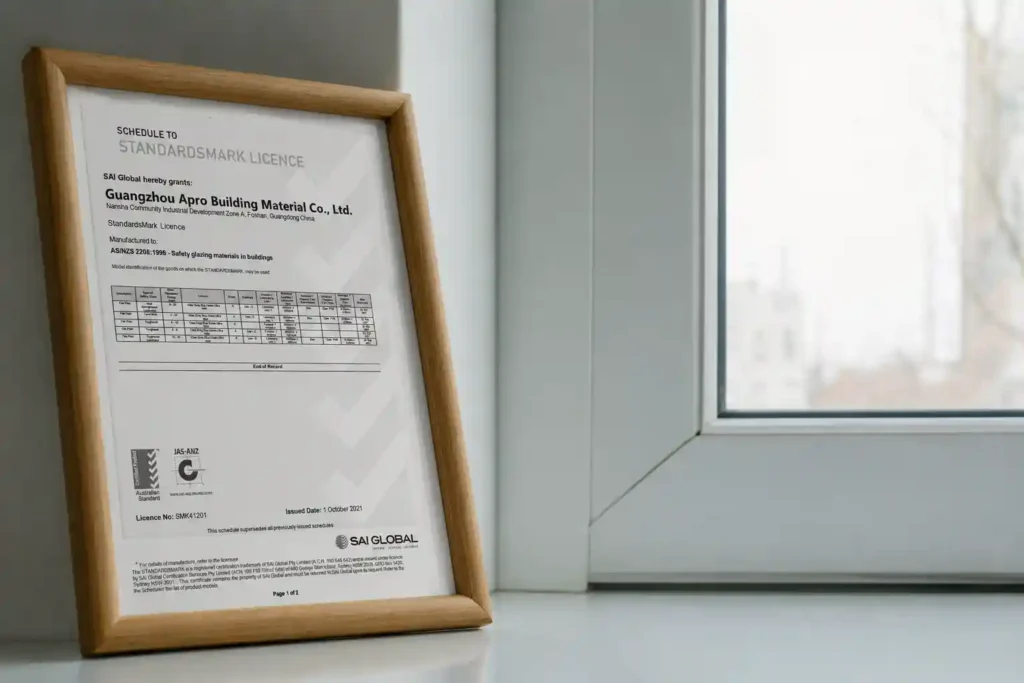
What a compliance statement needs to include depends on which nomination path applies. The table below splits this by path, plus what’s common to both.
| Nomination Path | What to Check | What to Ask the Supplier |
|---|---|---|
| Housing / residential (N1–N6) | The specific N-rating (N1–N6) the compliance statement applies to, and whether it matches the classification confirmed in Step 1 | Which N-rating does this compliance statement apply to, and does it match our confirmed building classification? |
| Commercial (design wind pressure) | The specific design wind pressure figure the compliance statement applies to — not an N-rating substituted in its place | Is this quoted against a design wind pressure, or has an N-rating been used as a stand-in for a commercial building? |
| Common to both paths | Test report or compliance document scope — a supplier may meet only one AS2047 performance criterion and disclose nothing about the rest | Does this cover structural adequacy, water penetration, air infiltration, and operating force, or only one of these? |
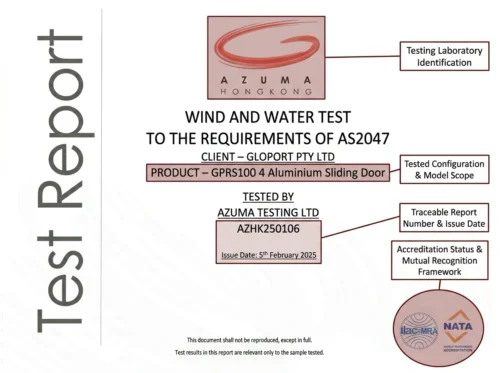
| Common to both paths | Frame and glazing configuration tested, and report number, issue date, and issuing body | Does the tested configuration match what’s specified, and can you provide the report number, issue date, and issuing body? |
Reading a Compliance Statement Correctly
A one-line claim without these details should be treated as incomplete, not accepted at face value — and a claim that doesn’t specify which nomination path it’s based on is incomplete by definition, regardless of how confident it sounds.
Manual Review Note
Do not accept or repeat a supplier’s compliance claim in project documentation until the nomination path, report number, issue date, issuing body, and tested configuration have been checked against the current project drawings and specification.
Framework Step 3: Review Quotation and Delivery Assumptions

Once the nomination path and compliance requirements are confirmed, the quotation itself needs to reflect the same information — not a generalized wind rating assumption.
- Confirm the quotation states the specific N-rating or design wind pressure it is priced against, matching the path confirmed in Step 1 — not a value from the other path.
- Check that the glass configuration, frame system, and finish in the quotation match the compliance documentation reviewed in Step 2.
- Confirm quantities and opening sizes in the quotation align with the current window and door schedule, not an earlier revision.
- Ask whether delivery timing assumes standard production or additional lead time for a higher classification or pressure rating, since these can involve different glazing or framing requirements.
- Confirm installation coordination requirements — access, sequencing, and site readiness — are noted where the classification affects fixing or anchorage details.
Why This Step Is Often Skipped
Quotation review is frequently treated as a pricing exercise only. Tying it back to the nomination path and compliance documentation confirmed in Steps 1 and 2 is what prevents a mismatch from surfacing after an order is placed.
Manual Review Note
Exact lead times, cost impacts, and installation sequencing should be confirmed directly with the supplier for the specific project scope — do not assume these are standard across all classifications, pressure ratings, or product configurations.
Risk Control Logic
Confirming the correct nomination path before anything else reduces several sources of downstream risk that a generic wind-rating check doesn’t address.
- Reduces classification risk by confirming whether the project — or a specific section of it — follows the N1–N6 path or the design wind pressure path, rather than assuming one from general appearance.
- Reduces certification risk by confirming the nomination path and building type match before drawings are finalized, rather than discovering a mismatch at certifier review.
- Reduces documentation risk by requiring report numbers, issue dates, and issuing bodies before a compliance claim is accepted, rather than relying on an unqualified statement.
- Reduces quotation and cost risk by tying pricing to the confirmed nomination path and configuration, which helps avoid cost surprises tied to a mismatched or substituted rating later in the project.
- Reduces coordination risk between design, procurement, and site teams by keeping drawings, schedules, and quotation aligned to one confirmed nomination path throughout the project.
This framework reflects general project-review logic, not a specific project case; APRO does not reference invented or unverified project examples or results when applying it.
Why the Classification Decision Comes First
Every other risk on this list compounds if the underlying nomination path is wrong. Confirming it first, before compliance documents or quotations are requested, is what keeps the rest of the review meaningful rather than built on an incorrect assumption.
Preparing to Move Forward

Once the nomination path is confirmed and Steps 1 through 3 have been worked through, buyers are ready to prepare project documents and approach a qualified supplier for review and quotation support.
Depending on project requirements, having drawings, the current schedule, the specification section covering wind classification or design wind pressure, project location, glass and finish requirements, and delivery assumptions ready in advance will shorten the review cycle with any supplier — including APRO.
APRO reviews AS2047 wind rating N1–N6 project details as part of its documentation-based approach to quotation preparation — starting from the confirmed building classification and nomination path, rather than quoting against a generic product line.
FAQ
What does N1–N6 mean under AS2047/AS4055?
N1–N6 is the wind classification scale used under AS4055 for housing and other residential buildings, ranging from N1 (lower wind exposure) to N6 (higher wind exposure). Cyclonic regions use a separate C1–C4 scale. It applies specifically to the housing/residential nomination path — not to commercial buildings.
Is N1–N6 nomination required for commercial buildings, or only residential/housing?
N1–N6 nomination applies to housing and other residential buildings. For commercial and other buildings, AS2047 instead requires the purchaser to nominate a design wind pressure for the window or door assembly, rather than an N-rating. Confirm which category a specific project falls into before assuming which nomination method applies.
How is the N1–N6 nomination different from the design wind pressure used for commercial buildings?
N1–N6 is a pre-defined classification derived from wind region, terrain, shielding, and topography, intended to simplify nomination for housing and residential buildings. A design wind pressure, used for commercial buildings, is a specific pressure figure rather than a named classification band. The two aren’t interchangeable, and one shouldn’t be substituted for the other on a compliance statement.
Can a single project have openings that need different nomination paths?
Yes. A mixed-use building can include residential-classified and commercial-classified sections, and each may follow a different nomination path. The window and door schedule should reflect this per opening or per zone rather than applying one classification to the entire building.
How do I confirm which nomination path and rating apply to my project site?
The building classification, and the resulting wind classification or design wind pressure, should be determined by the project’s engineer, certifier, or specification consultant, and should already appear on the drawings or specification. If it isn’t clearly stated, confirm it with the relevant project consultant rather than estimating it from location alone.
Does a supplier’s “N1–N6 compliant” claim on a quotation confirm the actual test scope?
Not on its own, and it’s incomplete by default if it doesn’t state which nomination path it’s based on. A compliance statement is only useful when it names the exact rating or pressure, the tested frame and glazing configuration, and includes a report number, issue date, and issuing body.
How does N1–N6 relate to BAL rating and other AS2047 compliance criteria?
N1–N6 wind classification and BAL (bushfire attack level) rating are separate requirements confirmed independently — meeting one does not confirm the other.
Conclusion / What to Do Next
Confirming an AS2047 wind rating N1–N6 requirement starts with one decision most buyers skip: whether the project follows the N1–N6 path or the design wind pressure path.
Everything after that — technical checks, compliance documentation, quotation review — depends on getting that classification right first, opening by opening if the project is mixed-use.
Before requesting a quotation, gather the current drawings, window/door schedule, the specification section covering wind classification or design wind pressure, project location, glass and finish requirements, and any known delivery assumptions — with the building classification confirmed in writing, not assumed. Having this scope confirmed — not just priced — is what keeps a project moving without rework.
CTA
For AS2047 wind rating N1–N6 project review or quotation support, send APRO the project drawings, window/door schedules, specifications, project location, glass requirements, finish and hardware requirements, delivery assumptions, and quotation scope.
APRO reviews these details starting from the confirmed building classification and nomination path, so pricing reflects the actual scope rather than a generic product line.