Commercial Window Test Reports Compliance Guide for Buyers
Verify commercial window test reports, laboratory accreditation, air infiltration, water resistance, and structural loads to eliminate project risks.
commercial-window-test-reports
Commercial Window Test Reports Compliance Guide for Project Buyers
In commercial construction and architectural fenestration procurement, third-party laboratory verification is the primary safeguard against on-site water intrusion, structural failure, and building code rejections. General contractors, architects, and procurement managers frequently encounter vendor proposals backed by ambiguous, outdated, or component-only laboratory documents. When unaccredited test certificates are accepted without rigorous verification, building envelopes face catastrophic air and water leakage under severe weather events. Establishing a disciplined engineering audit process ensures that supplied window assemblies match approved specifications and satisfy local building code requirements. This comprehensive technical guide establishes an engineering framework for evaluating commercial window test reports, identifying critical testing parameters, and confirming laboratory accreditation before issuing project purchase orders.
:::tip [Featured Snippet: Commercial Window Test Report Verification]
A valid commercial window test report is an accredited third-party laboratory document certifying an aluminum window assembly’s physical performance under standardized test sequences—specifically air infiltration (ASTM E283 / AS 4420.4), water penetration resistance (ASTM E331 / ASTM E547 / AS 4420.5), and structural wind loading (ASTM E330 / AS 4420.2). Project buyers must verify that the tested specimen dimensions equal or exceed project sizes, that profile extrusion dies match approved shop drawings, and that the testing laboratory holds active ILAC-MRA, IAS, A2LA, or NATA accreditation.
:::
المشكلة: لماذا يفقد مشتري المشاريع السيطرة؟
What it means
Project buyers frequently lose commercial and technical control when suppliers provide generic product brochures or component-level certificates instead of assembly-specific laboratory test reports. In commercial fenestration, glass performance is often confused with whole-window performance; a supplier presenting a Center-of-Glass (COG) acoustic or thermal report does not prove that their aluminum frame extrusion, EPDM perimeter gaskets, and structural corner joints can resist water penetration or wind loads.
How to apply
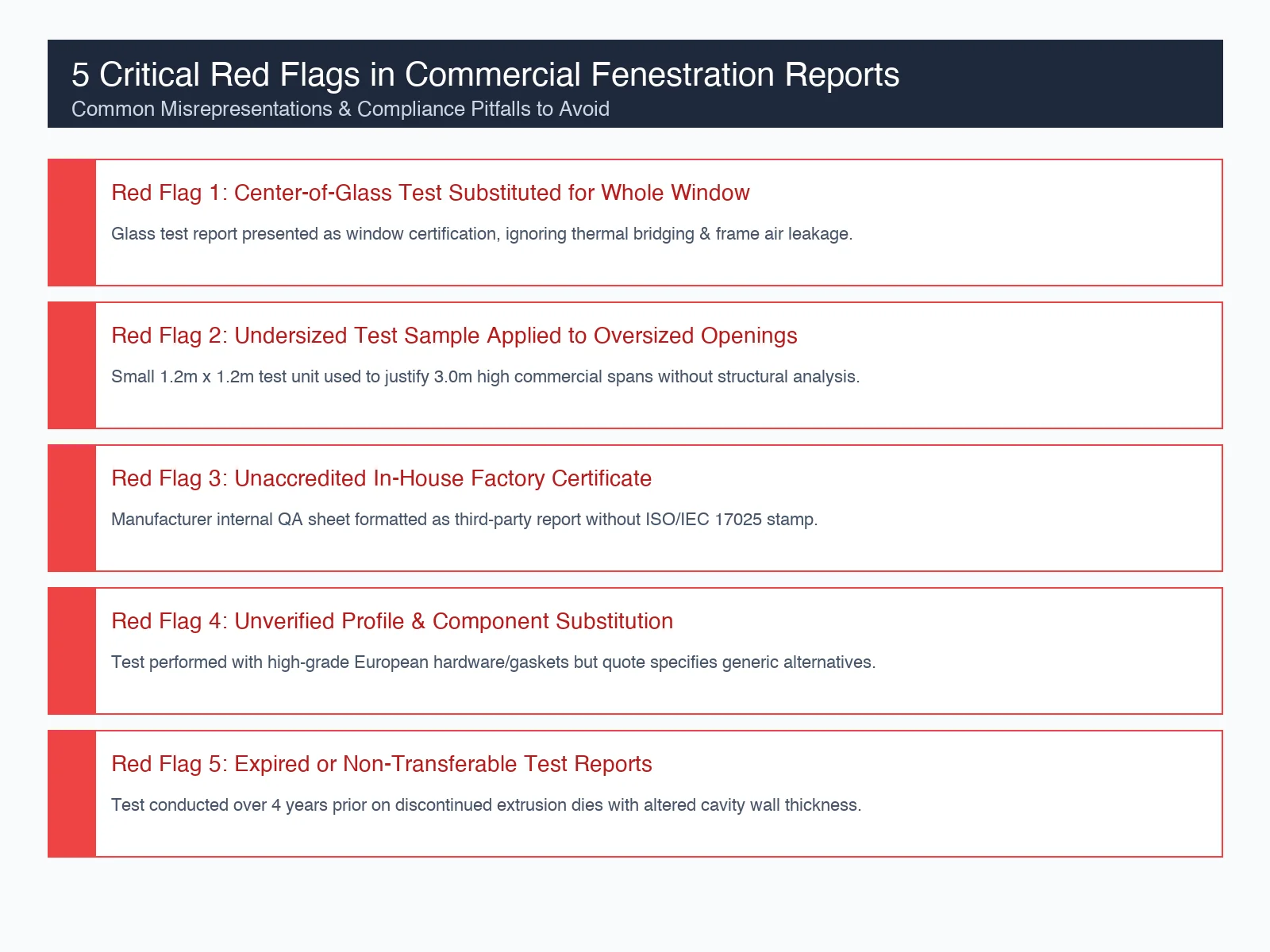
When reviewing supplier submittals, project teams must actively cross-reference submitted laboratory reports against five common project failure points:
1. Component Substitution: A report tested with high-end European hardware and gaskets applied to a quote utilizing cheaper local alternatives.
2. Specimen Size Mismatch: An accredited report based on a small 1200 mm × 1200 mm fixed window used to justify a 2400 mm × 3000 mm multi-lite commercial assembly without structural calculations. Cross-reference gateway size rules in our NAFS window performance ratings guide.
3. Partial Test Sequences: A supplier submitting an air infiltration report while omitting mandatory structural deflection and cyclic water penetration test sections.
4. Expired or Unaccredited Reports: Documents issued by unaccredited in-house testing rigs or third-party labs lacking mutual recognition agreements (ILAC-MRA).
5. Glass-Only Data: Providing an acoustic or thermal report from a float glass manufacturer to claim compliance for an operable aluminum window system. See our commercial window acoustic test report guide for frame sound-leakage risks.
Manual review note
Before accepting any test document, require the supplier to provide the complete, unredacted test report including profile cross-section drawings, specimen assembly photographs, hardware brand lists, English translation certificates, and the laboratory testing engineer’s official accreditation stamp.
Strategy Name: Project-Ready Supplier Review Framework
What it means
ال Project-Ready Supplier Review Framework is a systematic three-stage verification process designed to align architectural intent, structural engineering calculations, and laboratory test documentation prior to contract award.
How to apply
This framework shifts supplier evaluation from price-first bargaining to technical feasibility verification:
Manual review note
Utilizing this framework ensures that all competing bids are evaluated on equivalent engineering baselines, preventing unforeseen change orders and submittal rejections during construction.
الخطوة الأولى في إطار العمل: تأكيد النطاق والرسومات
What it means
Evaluating commercial window test reports begins with establishing an unambiguous scope of work based on verified architectural contract drawings.
How to apply
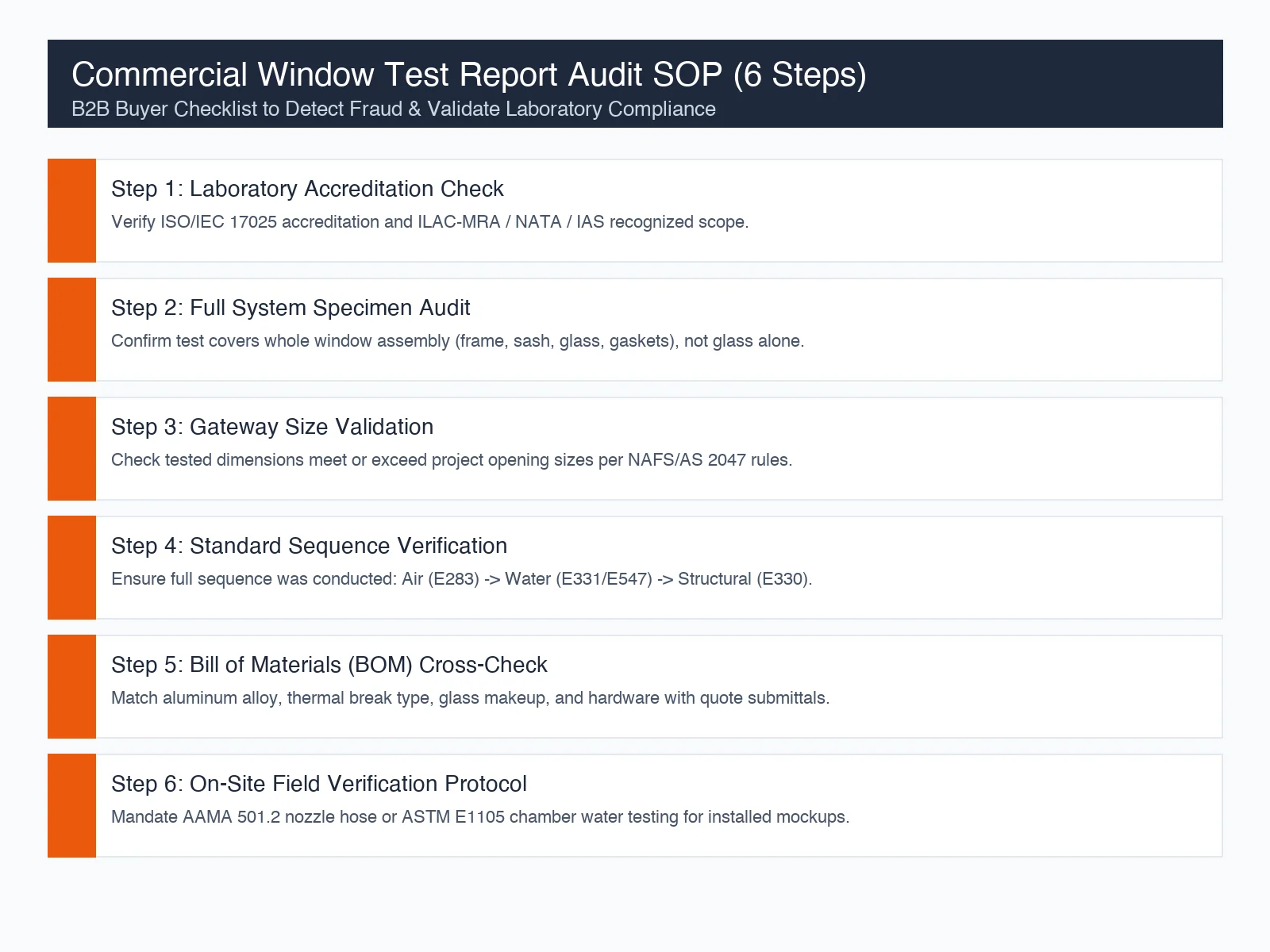
1. Map Opening Marks to Test Profiles: Correlate every mark in the window schedule (e.g., Mark W-01, W-02) with the specific aluminum extrusion system proposed by the manufacturer.
2. Verify Maximum Opening Spans: Identify the largest single-lite and multi-lite window configurations across the project to establish the required structural “Gateway Test Size.”
3. Confirm Surrounding Substrate Interfaces: Ensure that the perimeter anchoring method tested in the laboratory (e.g., steel clip angles into structural concrete vs. wood buck fasteners) corresponds to the actual jobsite structural substrate.
Manual review note
If project window spans exceed the dimensions tested in the manufacturer’s laboratory reports, require the supplier’s engineering team to submit finite element analysis (FEA) structural calculations showing that mullion stress and deflection remain within allowable limits (L/175 or L/240). Cross-reference submittal requirements in our window and door submittal package guide.
الخطوة الثانية من الإطار: التحقق من المتطلبات الفنية ومتطلبات الامتثال
What it means
A rigorous technical audit verifies that the test report adheres to recognized international testing methodologies and that recorded physical performance values satisfy project specifications.
How to apply
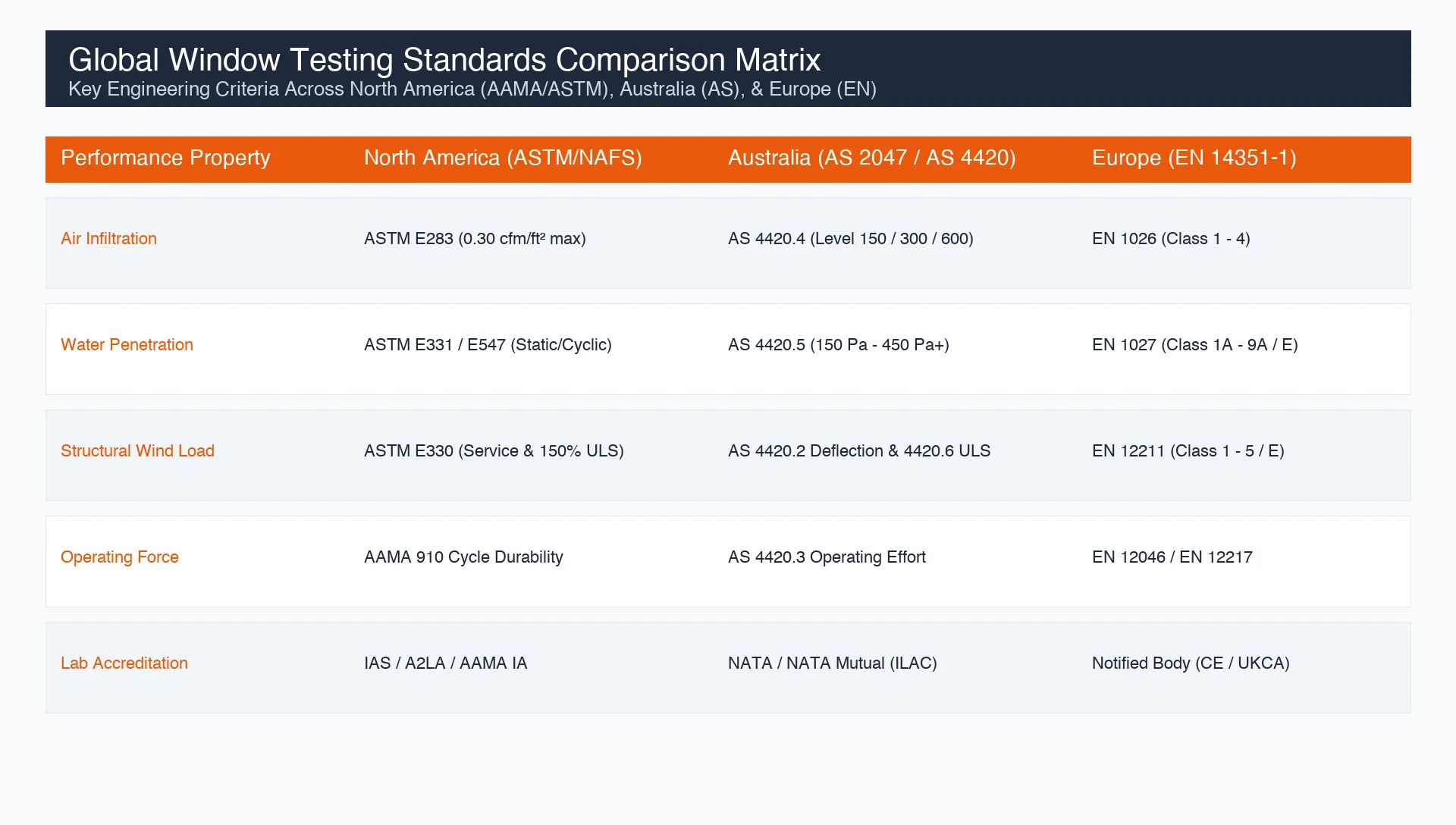
1. Verify Air Infiltration (ASTM E283 / AS 4420.4): Review whether the air leakage rate was measured under both positive and negative pressure differentials. For commercial air-conditioned buildings, ensure the leakage rate does not exceed 0.1 cfm/ft² (1.0 L/s\cdotm²).
2. Audit Water Penetration Resistance (ASTM E331 / ASTM E547 / AS 4420.5): Confirm whether water testing was static (ASTM E331) or cyclic (ASTM E547). For commercial architectural projects, static testing must reach at least 15% to 20% of positive Design Pressure (minimum 300 Pa to 580 Pa). Verify that no water leakage penetrated past the innermost plane of the window frame.
3. Evaluate Structural Wind Load Resistance (ASTM E330 / AS 4420.2):
4. Confirm Laboratory Accreditation: Ensure the testing facility is accredited under ISO/IEC 17025 by recognized bodies such as IAS (International Accreditation Service), A2LA, NATA (Australia), or ILAC-MRA signatories.
Manual review note
Check the report header for the laboratory’s unique accreditation certificate number and verify its validity on the accreditation body’s online directory.
الخطوة الثالثة من الإطار: مراجعة افتراضات عرض الأسعار والتسليم
What it means
A valid test report must translate directly into clear manufacturing specifications, quotation line items, and delivery logistics.
How to apply
1. Match Extrusion Die Codes in Quotes: Ensure that the aluminum profile model numbers listed in the formal quotation match the exact die cross-sections illustrated in the laboratory test report.
2. Verify Glass and Gasket Build-up: Check that the quote includes the specified glass thickness, polyamide thermal break strips (PA66 GF25), and vulcanized corner EPDM gaskets required to replicate test performance.
3. Clarify Logistics and Protection: Confirm that windows will be crated with structural corner protectors, moisture barriers, and clear Schedule Mark ID labeling for seamless site receiving. Review commercial aluminum window systems and packaging standards during commercial review.
Manual review note
Ensure that quotation terms clearly state that all supplied window units will be manufactured using identical extrusion profiles, corner joining techniques, and hardware assemblies as documented in the approved test report.
سياق المشروع (مجهول الهوية)
What it means
In a mid-rise commercial development, the procurement team initially received a low-cost bid claiming full compliance with ASTM structural and water penetration standards. Upon technical audit using this framework, the submitted test report revealed three critical discrepancies:
How to apply
By identifying these gaps before issuing the contract, the general contractor required the manufacturer to submit authentic test reports for their commercial operable series with verified 500 Pa water penetration data, eliminating potential façade failure and costly remediation.
Manual review note
An engineering audit conducted during tender evaluation protects general contractors from contractual liability and schedule delays during architectural submittal sign-off.
Risk Control Logic and Field Verification
What it means
The risk control logic establishes multiple defense layers across design review, factory quality control, and on-site testing.
How to apply
1. Audit Upstream Test Reports: Verify physical test data before signing manufacturing agreements.
2. Enforce Factory Quality Assurance: Require factory inspection test plans (ITPs) verifying corner crimping injection glue, continuous EPDM gasket seating, and water drainage chamber routing.
3. Plan for Field Verification Protocols:
Manual review note
Field water penetration testing should always be scheduled immediately after the first 3 to 5 window units are installed, allowing installation corrections before full-scale installation proceeds.
كيف يمكن لمشتري المشاريع تطبيق هذا الإطار
What it means
Turning technical testing knowledge into practical procurement execution requires a standardized action plan.
How to apply
1. Compile the Specification Package: Gather architectural elevations, schedules, glass specifications, and performance targets into a single submittal folder.
2. Issue the Technical Questionnaire: Require shortlisted suppliers to complete a compliance matrix confirming profile wall thickness (≥ 2.0 mm for commercial profiles), test report numbers, and laboratory accreditations.
3. Engage Engineering Review Early: Partner with an experienced manufacturer like منظمة أبرو for preliminary shop drawing analysis, structural calculations, and compliance verification.
Manual review note
Suppliers demonstrating transparent engineering support, authenticated laboratory reports, and clear scope boundaries represent significantly lower total project risk than vendors competing solely on unit price.
How can a contractor verify if a window test report is authentic?
To verify authenticity, check that the testing laboratory is accredited under ISO/IEC 17025 by an internationally recognized body (e.g., IAS, A2LA, NATA, or ILAC-MRA signatories). Cross-reference the laboratory report number on the accreditation agency’s public database, and inspect the report for detailed engineering drawings, assembly photographs, and the testing engineer’s signed stamp.
Does a glass manufacturer’s test report cover the entire aluminum window?
No. A glass manufacturer’s test report only certifies the optical, thermal, or acoustic properties of the center-of-glass (COG) unit. It does not evaluate frame structural deflection, air leakage through perimeter gaskets, or water penetration through corner joints and drainage weep systems. Full compliance requires whole-assembly window testing.
What is the difference between Serviceability Limit State (SLS) and Ultimate Limit State (ULS)?
Serviceability Limit State (SLS) evaluates window performance under standard operational wind loads, ensuring that structural members do not deflect beyond allowable limits (typically L/175) and operate normally without air/water failure. Ultimate Limit State (ULS), tested at 150% of design wind pressure, evaluates structural safety under extreme wind gusts, ensuring the window does not detach, collapse, or suffer glass blowout.
Can test reports from overseas laboratories be accepted by North American or Australian building inspectors?
Yes, provided the overseas laboratory is ISO/IEC 17025 accredited and holds mutual recognition through the International Laboratory Accreditation Cooperation (ILAC-MRA). Test protocols must strictly follow the required local standards (e.g., ASTM E283/E330/E331 for North America or AS 4420 / AS 2047 for Australia) with certified English drawing submittals.
What should project buyers confirm before requesting a quotation for commercial window test reports?
Project buyers should confirm project wind load criteria (positive and negative Design Pressure), water penetration test targets (in Pascals or psf), maximum opening sizes, profile thermal break requirements, and glass configurations.
كيف يمكن للمشترين تقييم الموردين بما يتجاوز سعر الوحدة؟
Buyers should evaluate suppliers by auditing third-party lab test validity, profile extrusion structural section modulus (I_xx), hardware warranty tiers, shop drawing engineering responsiveness, and factory export packaging standards.
Navigating commercial window test reports is essential for mitigating structural, water leakage, and project sign-off risks. By applying a structured review framework, general contractors and commercial project teams can ensure that supplied window assemblies deliver verified performance under real-world building loads.
Recommended Project Actions:
1. Collect and review all project fenestration performance specifications (CSI Section 08 51 23).
2. Request complete, unredacted third-party laboratory test reports from prospective manufacturers.
3. Audit laboratory accreditation credentials and compare tested specimen dimensions against project schedules.
4. Partner with an engineering-focused manufacturer to review shop drawings and structural calculations.
For technical review of your project’s commercial window test reports, drawings, and performance specifications, contact APRO’s engineering team. Submit your architectural elevations, window schedules, and compliance targets for a detailed technical feasibility review and competitive quotation package.